

n college, I got an English degree. This made many people very angry and has been widely regarded as a bad move… but those people were wrong. Studying the humanities was (and is) a good investment, and no amount of artificial intelligence, job market fluctuation, or postmodern simulacra can change that.
The mistake isn’t studying the humanities in the age of AI. The mistake is assuming AI and humans are competing in the same game.
As I write this, I’m 30 years old, which makes me a millennial, albeit a younger one. I started college in engineering and changed my major, which was generally considered a risk.
Why bother with the humanities with AI on the horizon, and why should you bother with them now that AI has arrived? Is studying the humanities still worth it? I would argue that yes, it is. Perhaps more so than ever.
After a decade working at the intersection of technology and communication, I’ve spent a lot of time thinking about these questions. Here’s what I’ve learned:
- Things are changing too fast for sweeping judgement calls to stick
- Human intelligence and artificial intelligence have wildly different goals
- Generative AI is not an accurate name
- You’re the only one who can weigh what’s worth it in your life
- Getting what you want out of life has less to do with your job than you think
Let’s get into it.
Everything is changing all of the time.
Throughout my academic career, I heard – like I’m sure you have – that STEM is the way of the future. That writers and translators (and even “prestigious” jobs like lawyers and business analysts) will be automated away, but society will always need doctors and engineers and programmers to keep things running.
But the data is coming in. Artificial intelligence is impacting employment, and the hardest hit industries are all over the board. According to ADP Research Institute, the biggest impact has been on:
- Customer service, a job title that appears across virtually every industry
- Marketing, another job that appears across practically every industry
- Software development… one of those supposedly ironclad STEM careers we always heard would be safe
Which means humanities are not the only industries that AI is changing. Everything is changing. It always has been, but AI means it is changing in seismic ways, faster than before.
The real issue isn’t that humanities are obsolete. It’s that no field is truly insulated from automation.
Not to mention, the very existence of AI is affecting our ability to be successful in those fields. Critical thinking skills, for example, are essential for anyone studying a STEM field, and using AI to solve problems is already reducing our ability to be effective critical thinkers. So we’re getting worse at STEM skills, while AI continues to optimize for them.
The key to surviving and even thriving in such a crazy landscape is learning how to adapt.
You’ll need to future-proof any career you go into, no matter what field. So you might as well have a realistic game plan from the beginning and choose a path that will make you happy.
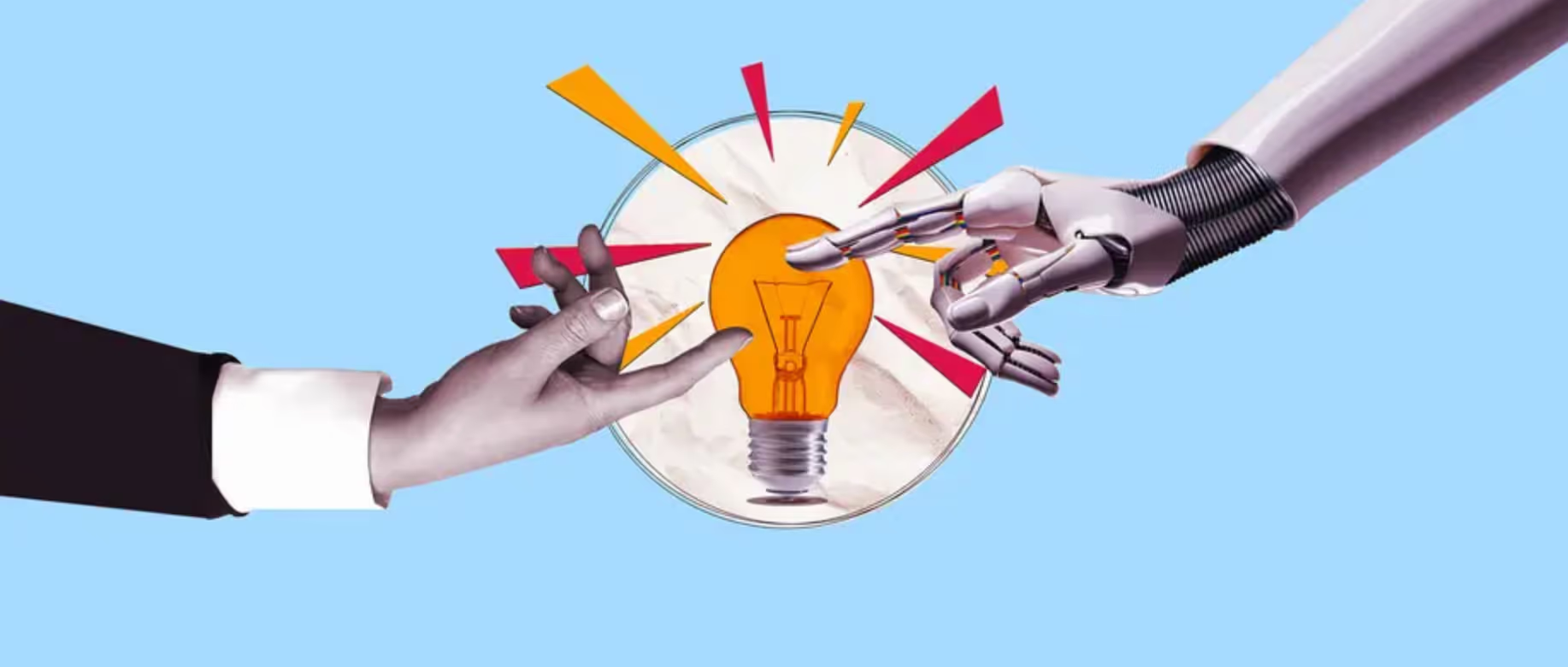
Humans and AI don’t have the same goals.
Some things simply aren’t relevant to computers, but they’re essential to humans.
Computers and programs, at their core, are designed to solve problems. They can be simple, like inputting 2+2 into a handheld calculator, or they can be more complex, like asking a search engine to cull the entirety of the internet for the answer to your search for the best blueberry pancakes recipe.
Given some information, derive the answer.
Now with the advent of AI, the solutions they offer are more sophisticated, but at the end of the day, it’s still the same basic directive:
Given some information, generate the statistically most likely answer.
If that’s the goal, what allows a program to be good at what it does? Speed. Clarity, Efficiency.
But what about humans? What do we fundamentally do?
There are easy answers, but they fall apart upon any sort of closer examination. To continue the species… then what of people who can’t or choose not to have children? To find the thing they’re excellent at, and do that for the good of humanity… but what about people who have real limitations blocking them from doing what they do best?
There are countless ways to define meaning in human life and humanity as a whole. We’ve been debating it for centuries. But no matter which definition you subscribe to – even if you believe there’s no meaning at all – the directive driving human life is far more complex than the one driving even the most complex machine.
As a human, if you limit the markers of success to clarity and efficiency, you miss out on a lot. You erase ambiguity, obligation, loyalty, love, grief — the intangible things that actually constitute a life. There’s no time to stop and smell the roses, appreciate the journey over the destination, or carpe the diem.
There are innumerable ways for a human to be valuable. Which also means there are innumerable ways to be good at achieving that value.

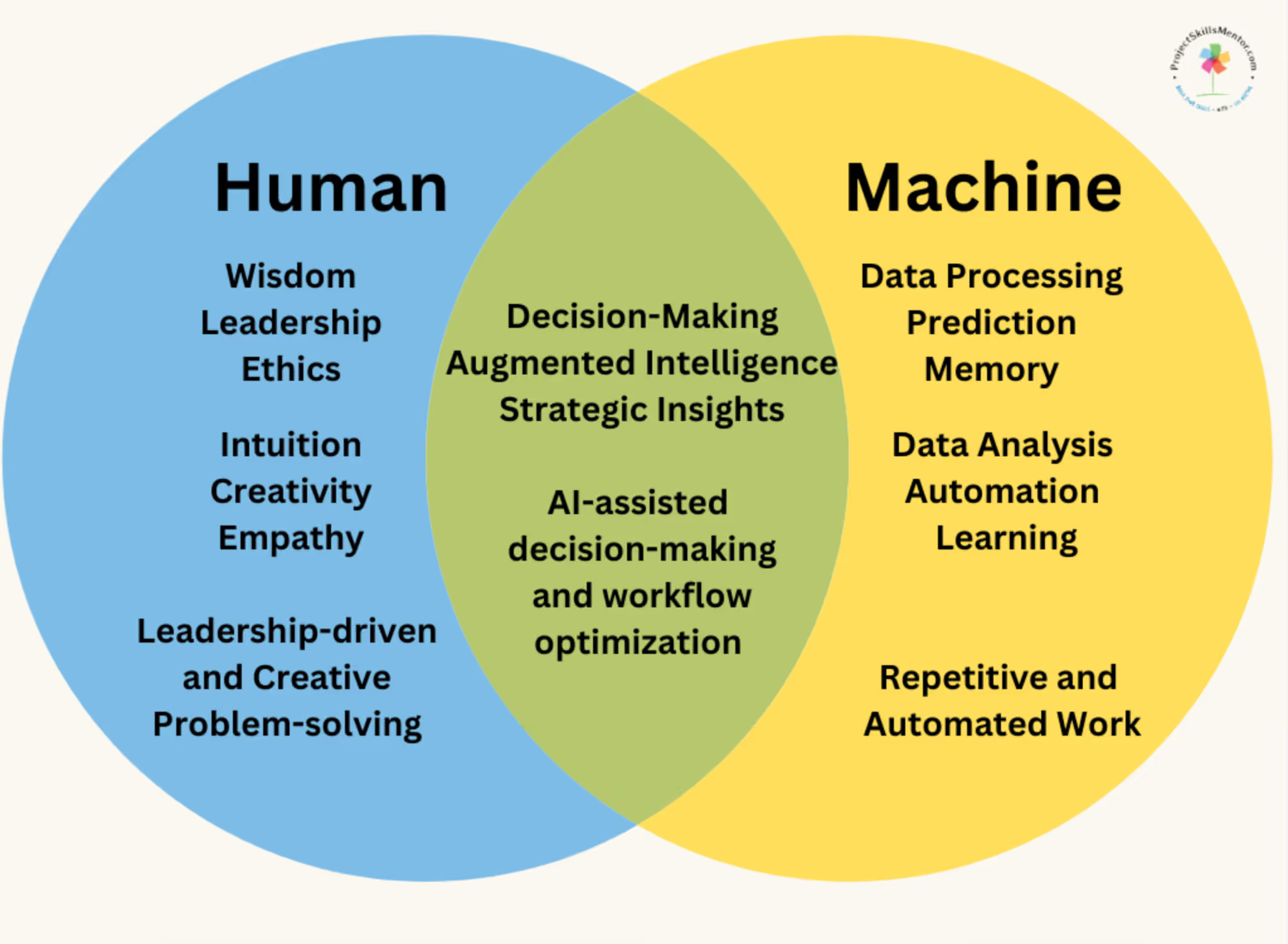
That being said, humans are social creatures, and the research is very clear that forming strong relationships is key to the human experience. And there are skills that help us achieve that goal, like being empathetic and behaving morally so we don’t get kicked out of our social groups.
Computers don’t need empathy. They have no prerogative to behave morally. It doesn’t help them achieve their task any better.
AI systems don’t pursue ethics unless we explicitly code ethical constraints into them. Their objective is optimization, not connection. They do not experience the consequences of their outputs. Humans do. That single fact changes everything.
AI is oriented around speed, scale, and pattern recognition. Humans are oriented around judgment, meaning, and impact. Yes, there can be overlap between those goals and the skills we use to achieve them, but they are not the same game.
That's part of the reason why the humanities are so valuable. The humanities teach skills that artificial intelligence has no need for and therefore will always struggle to replicate, let alone replace.
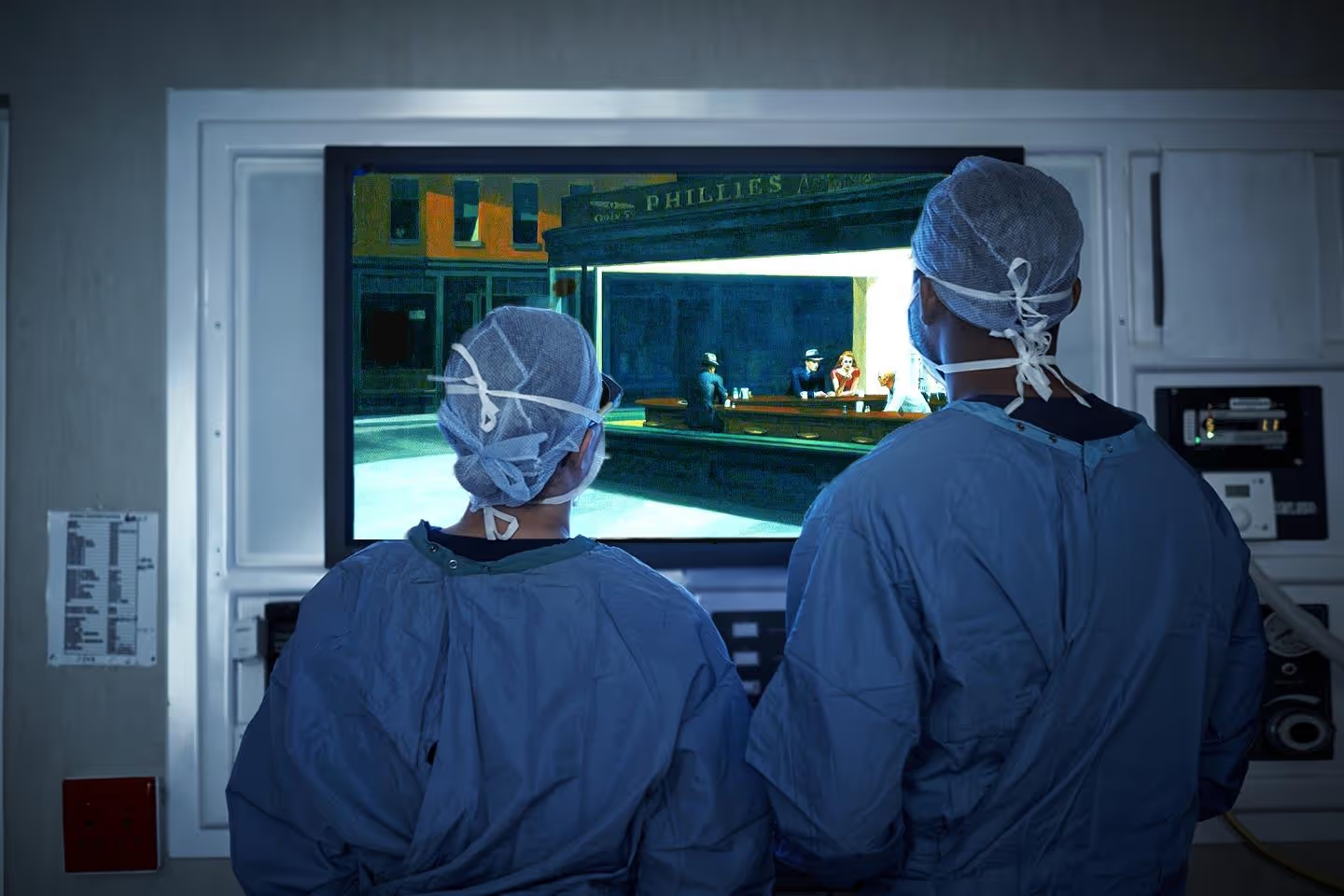
Even within STEM fields, it’s all but impossible to separate art and science entirely.
Consider medicine, something we tend to think of as a strictly scientific pursuit. Some of the most prestigious medical schools in the world, including Johns Hopkins University, use fine art to teach the next generation of doctors essential skills. Not because art makes students better at memorizing anatomy or chemical reactions, but because it sharpens their abilities of observation, interpretation, and empathy – skills that no diagnostic algorithm can fully automate.
Generative engines are misnamed.
I warned you that I was an English major, so bear with me for a minute.
The word generate comes from the Latin word genus, meaning birth or stock, and the related verb generō, meaning to produce, beget, or procreate.
The important idea here is that it’s not just about making something. The thread connecting these definitions is the idea that you’re putting a part of yourself into the thing you create. By the simple fact of you being the one to create it, there is a little piece of you that is carried forward into your creation.
That’s why I don’t think the name “generative” AI is very accurate. It misrepresents what these algorithms are doing. AI doesn’t actually generate anything. Not because AI fails to produce outputs, but because production is not the same as authorship.
AI, like humans, is good at noticing patterns and figuring out what fits into them. It can fill in the gaps between ideas that already exist. It can guess, based on existing ideas, what the next great idea might sound like. But it cannot come up with an idea for itself. It cannot care that the idea exists. It has no reason to.
It cannot choose to create.
True creation is distinctly human.
You might argue that humans are also a product of the information we take in. And to some extent, that’s fair. But we're more than the sum of our parts. Even working with the same facts, each of us is a unique product of data, ideas, genetics, and experiences that can lead us to draw different – even unexpected – conclusions.
We are inspired by the work and people around us, which is why you may have heard any number of quotes about everything being a copy of a copy of a copy at this point, or an imitation of an imitation. Whether it was sung to you by Trent Reznor or delivered on screen by Ed Norton or printed on the page by Chuck Palahniuk, we have long held the idea that because we use the same building blocks as other people, what we produce is not new.
But it is. What you make is unique because it is filtered through you.
Through millions, billions, or more tiny perceptions, memories, and stimuli interacting in infinite predictable and unpredictable ways. Meaning you are the only person who could create this creation — whether it’s a work of art, a poem, or just an email — exactly as it is. Statistically, it’s all but impossible for anyone else to get all of the variables lined up exactly the same way again. Even you. If you tried to create the same thing a week from now, a year from now, or two years ago, it would be different. Given the same information, you could arrive at a wildly different product.
AI can simulate personal depth and diversity of experience, but it does not live them or embody these things. Its responses might evolve, but in predictable ways.
Not to mention, when a human creates, something is at stake. Reputation. Identity. Belonging. AI can’t feel or experience risk and reward this way. It has no skin in the game, so to speak. So the way it plays the game will always be fundamentally different from when a human seizes the spark of inspiration to create.

Deciding what’s “worth it” is deeply personal.
Figuring out if something is “worth it” and if it’s “worth shelling out thousands of dollars to study at a university” are two very different questions. But the humanities still deserve to be part of the conversation.
In today’s rapidly changing professional world, it’s nearly impossible to make broad claims about what will or won’t be useful. Algorithms deliver different information to each of us, creating niches that didn’t exist a decade ago – from niche language to niche interests.
Not long ago, we shared a common cultural baseline: the same news, the same TV shows, the same trends. It was easy to know what people cared about and to predict what would come next. But not anymore. Who can tell what hyper specific thing will become the next trend, whether it’s a micro fashion trend or absurdist slang or a hyper specific industry that’s going to take off if you can cash in before your feed refreshes? Who can tell what kind of knowledge will be most useful, or how long it will be useful before the next shift moves the goal posts again?
When everything is changing, and rapidly, all of the time, general statements like “STEM jobs are stable” lose their meaning. What’s more useful is figuring out where you want to end up and comparing the cost versus the reward of the different strategies that will get you there.
It’s about the return on investment for you.
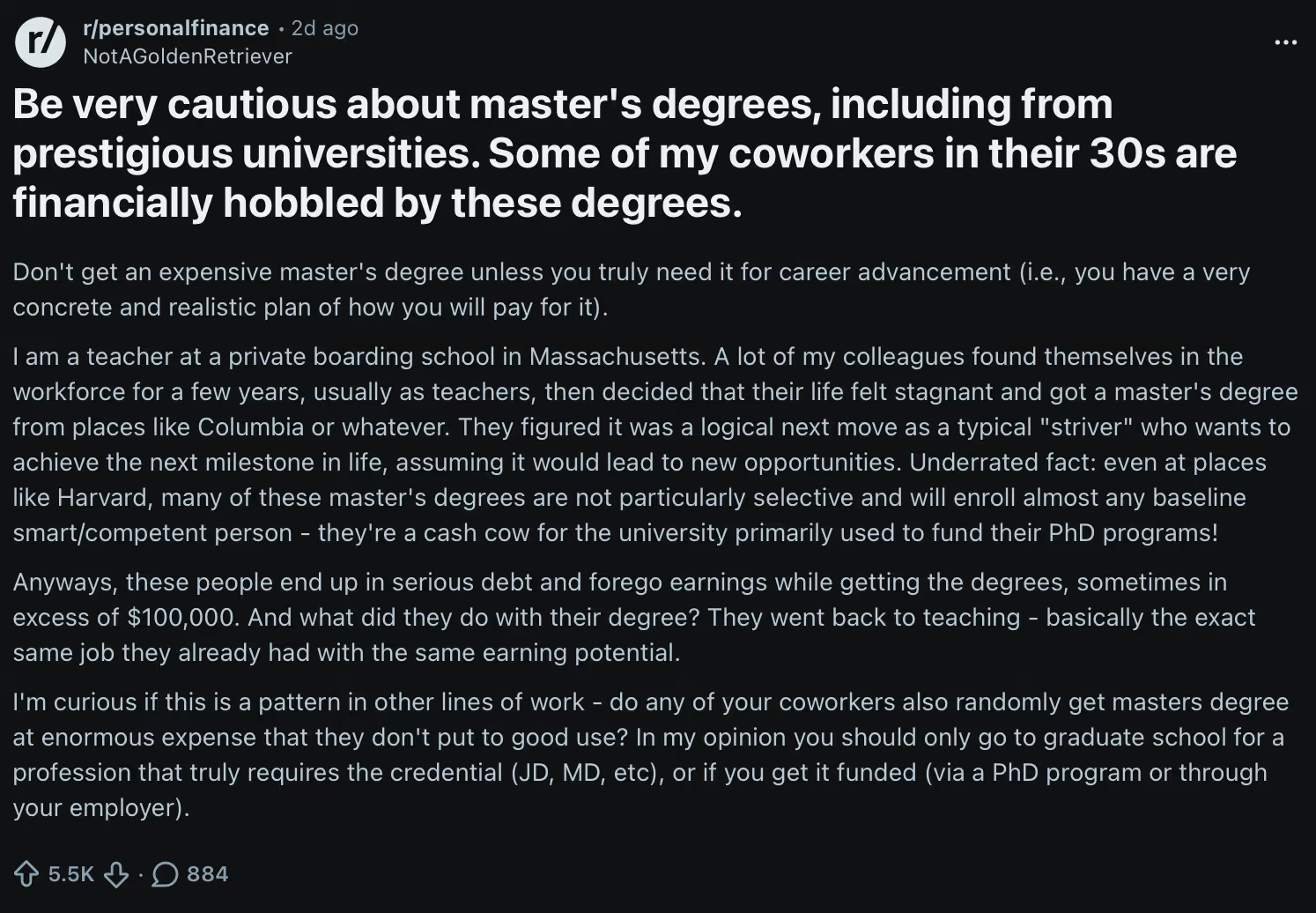
Is it worth getting a Masters, or a PhD, or going to college for it at all? Should you get that certificate, or learn it for free on Youtube, or just find a mentor? There’s no one-size-fits-all answer.
Instead, ask yourself:
- What are the requirements to get into what you want to do?
- Is the payoff you’ll get worth the money you’ll have to put into it?
- Can you spend less and still get where you want to be?
Sometimes the answer isn’t money. If all you have to invest is time, then is it worth it?
You can absolutely still decide that it’s worth it to you to study something that won’t land you a big salary or a lot of prestige, you’ll just want to be smart about how you engage with it. For example, if your dream is working in a museum — a field notoriously saturated with overqualified applicants — paying thousands for a top-tier Master’s won't guarantee a job, so for most people, it’s not a sound investment. Instead, you might find flexible work, volunteer, and gain hands-on experience that gets you closer to your goal without the massive price tag while you do something else to pay the bills.
Ultimately, you can study anything you want. The real question is what resources — money, time, and energy — you’re willing and able to invest to get there.
AI might change the work landscape, but it doesn’t change what matters to you.

Build a career that fits your life goals, not the other way around.
Something that has surprised me about post-graduate life is how in some ways the big decisions matter a lot, and strangely, at the same time, they matter very little.
Sure, your career matters. A job can be a good job because you love what you do, or because it supports your lifestyle, or because you love the people you work with. If you’re very lucky, you’ll get all three. But even if your career is exactly what you dreamed it would be, it’s likely not enough on its own for a fulfilling life.
The same is true of relationships. The people you surround yourself with shape your experience, but once those relationships are in place, you’re still moving forward—chasing other goals, learning, growing, and becoming the person you want to be.
So chasing a career in STEM can be great… if that fits into what you want out of life. But it isn’t the end-all, be-all of academic or professional success, let alone personal success.
It’s all about balancing where you want to allocate your interests and abilities. Are they better expressed as professional skills or as hobbies? Are they things you do for a paycheck because you’re good at them or things you do for personal fulfillment? Do they need to be both? Probably not.
For my own part, I’m happy with my decision to get an English degree. There have been trade-offs, but choosing the humanities has afforded me opportunities I don’t think I would have had if I had stuck with my original plan of engineering. Like:
- Working with a team of creative, hungry young entrepreneurs putting everything they had into making their dreams happen
- Receiving grants to research topics I’m genuinely fascinated by
- Striking a balance between traveling, working, and working while traveling
- Challenging myself to keep learning new things because my job is always evolving
- Learning from brilliant, passionate people I am grateful to call my mentors, colleagues, and friends
- Having the flexibility to be with loved ones during important moments, particularly as the number of moments I’ve had with older loved ones have run out
Can you achieve those same things with a STEM job? Sure you can. But it wasn’t for me.
So while it might seem scary to pursue the humanities right now, it can pay off. What matters most is knowing where you want to go and shaping a career that fits your life, rather than forcing your life to fit a particular career.
For me, studying the humanities has been worth it.
To be clear, this isn’t an anti-STEM argument. Science, technology, engineering, and math are obviously important.
My point is simply that the challenges facing the humanities are the same ones facing every industry – so if pursuing the humanities or any other field is what will allow you to get what you want out of life, don’t let vague fears about the professional world changing hold you back. We’re all in the same boat here.
I’ll leave you with a quote from one of my favorite speeches of all time, written for a Stanford commencement ceremony by Apple co-founder and STEM golden child Steve Jobs:
“You have to trust in something, your gut, destiny, life, karma, whatever, because believing that the dots will connect down the road will give you the confidence to follow your heart, even when it leads you off the well-worn path, and that will make all the difference.”